
Unrehearsed Artist Residency 2026
Art Share: Day 1 Program
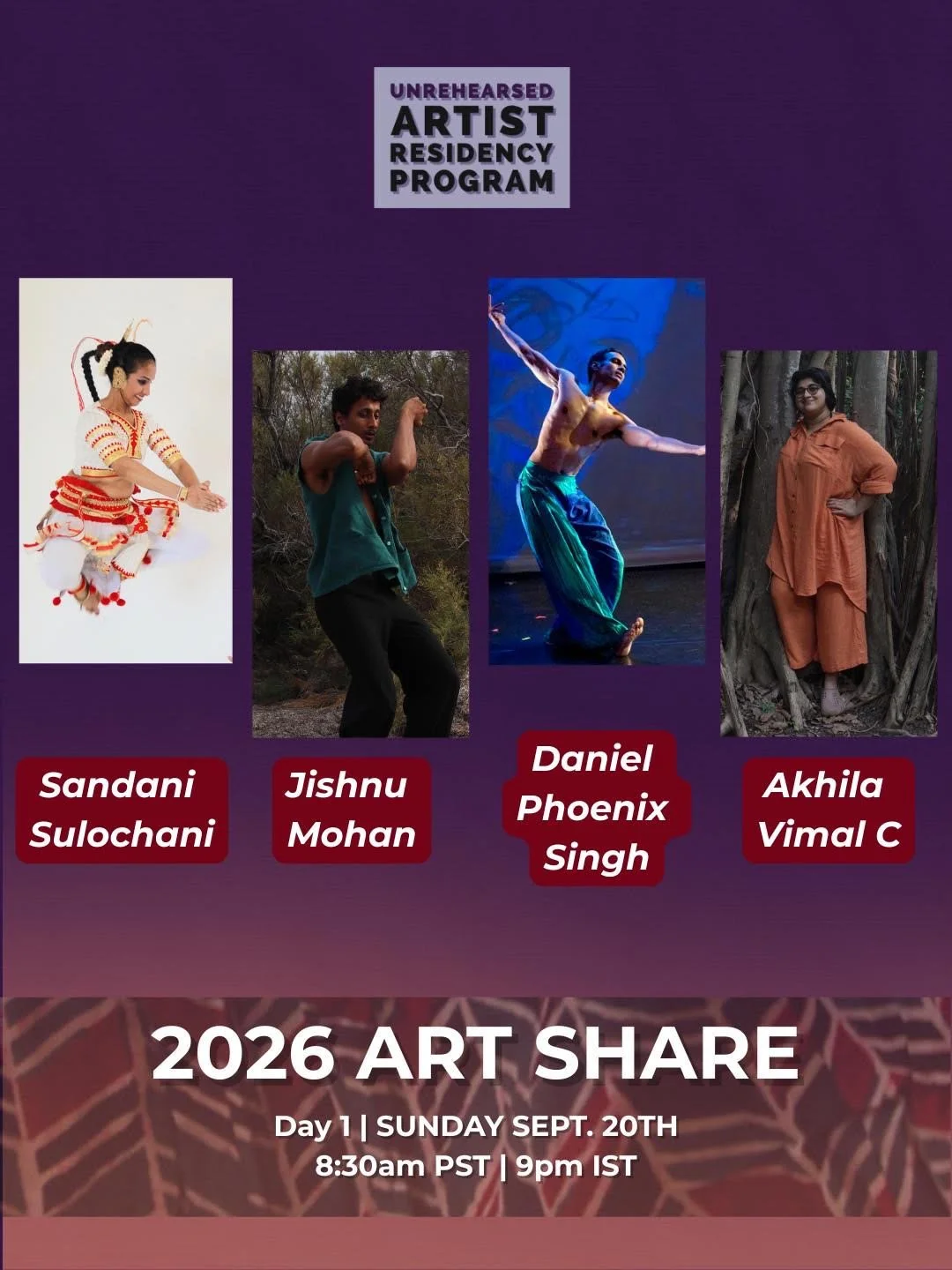
Program
Land Acknowledgement
Welcome
Art Shares by Akhila, Jishnu, Daniel, Sandani
Artist Talk Back
Akhila Vimal C (Varanasi, India)
Akhila Vimal C is a performance theorist, ecocultural strategist, and disabled mover exploring how bodies think, remember, and resist. Her work moves between intercultural performance traditions, access-centered pedagogy, and ecological justice. Her recent interest turns toward forgotten stories and traditional storytelling methods—an academic focus now evolving into an artistic inquiry. She treats these narrative lineages as living archives that shape how communities hold memory and continuity.
She builds frameworks for cultural continuity and accessibility through research, creative practice, and community-led knowledge. She founded AccesIndia Collective, a practice-based initiative developing access-driven approaches for arts spaces, institutions, and community environments, including access consultancy for diverse public and cultural contexts.
Across her work, she explores access not as an afterthought but as a generative artistic logic—one capable of imagining new futures for performance, spectatorship, and collective life.
A note about the piece:
This work is rooted in stories of women whose pursuit of knowledge was met with violence and silence. I’m beginning with two figures: Muchilottu Bhagavathi, also known as Devakanya, from the Theyyam tradition of North Malabar, and Nangai, whose story comes from a different regional and social context. I’m interested in what remains when a woman’s knowledge is erased from history—what gets carried through the body, through land, memory, and oral storytelling.
For this sharing, I’m working with trees and my movement around them. I’m thinking of the trees as witnesses, archives, and living presences. Rather than trying to recreate these women’s stories literally, I’m exploring how their stories might be remembered through the body, and through my relationship with the landscape.
Muchilottu Bhagavathi / Devakanya
Muchilottu Bhagavathi is a Theyyam deity associated with the Vaniya community of North Malabar. In one widely told version of her story, she was a young Brahmin woman named Devakanya, known for her exceptional learning and ability in scholarly debate. When she defeated male scholars, they questioned her knowledge and eventually used her answers about pleasure and childbirth to cast doubt on her sexual purity. Ostracized and publicly shamed, she entered fire. In the story, she later becomes Bhagavathi and is worshipped as a powerful goddess.
For me, what remains is the contradiction at the heart of the story: a woman is punished for possessing knowledge, and only after her destruction is that same woman transformed into someone worthy of worship.
Nangai
Nangai comes from a different social and cultural location, and that difference is important to the work. Her story is also carried through regional oral traditions and concerns a woman whose desire for knowledge and engagement with religious texts challenged the role prescribed to her. In accounts of the story, her pursuit of learning becomes a transgression, and she is killed; her story then continues through a process of deification and remembrance.
I’m interested in holding these women together without making their experiences the same—one comes from a Brahminical scholarly lineage that I have a complicated proximity to, while Nangai’s story asks me to think about caste, distance, and the ethics of representing someone whose lived experience I cannot claim.
The work is not an attempt to recreate their histories literally. I’m thinking about what happens to a woman’s knowledge when the person carrying it is silenced—and what the body remembers after the story has been erased.
Project Artists & Contributors
Video & Editing: Amruta R
Voice-over & Audio Description: Amruta R, Villadichanpattu, Veronica Angel, Teyyam Song, Unnikrishnan Peruvannan
Honouring the voices, art, and living traditions that keep our heritage and memories alive.
Jishnu Mohan (Ernakulam, India)
Jishnu is a movement artist and performer trained in Contemporary, Hip-hop, House, Locking, and Kalari. He has studied under various teachers and received mentorship from artists across India and abroad. At 30, he holds a bachelor’s degree in English Language and Literature.
Jishnu completed a 7 week residencial program on somatic movement in Greece and multiple intensive residetial movement programs in India.
His work often carries traces of his preparation for the civil services examination, reflecting a deep engagement with critical thought and inquiry. Through his performances, Jishnu seeks to pose difficult questions and encourage audiences to think for themselves.
Project Collaborators: Aal Studio.
Daniel Phoenix Singh
Washington DC
Daniel Phoenix Singh has worked in Higher Education, the field of Dance, Queer Communities, South Asian Communities, and in Arts practice, policy, and funding at local and national levels.
Daniel began his journey in Bharata Natyam with Guru Meena Telikicherla of Nrityanjali. In his modern dance practice, Daniel was mentored by Pamela Mathews as curiosity took him from computer science to a dance major in college. He is deeply grateful to Lorry May, Harriet Moncure Williams, and Karen Bernstein for helping shape his choreographic voice. Mallika Sarabhai, Madhavi Mudgal and Leela Samson in India have broadened his perspectives on the space Indian dance forms can occupy within the body, in the pedagogy, and in the field of dance.
He acknowledges the complicity and internalization of colonial, racial, and caste-based oppressions in his life and works hard to approach issues from an anti-caste, anti-colonial, and anti-racist perspective in all his work, especially dance. He has been influenced by the work of Erode Venkatappa Ramasamy (aka Periyar), Bhimrao Ramji Ambedkar, Rabindranath Tagore, Arundhathi Roy, Toni Morrison, Nrithya Pillai, Pallabi Chakravorty, Vidhya Shanker, and particularly Justin Laing who work from anti oppression frameworks.
He is a single parent to amazing twins who have been his foremost teachers and test his improvisational skills every day.
Dancer: Aishwarya Vepa
Video without Visual Description
Video with Visual Description
Sandani Sulochani
Los Angeles, CA
Sandani Sulochani is a Sri Lankan dancer, choreographer, teacher, and scholar with rare training in all three of Sri Lanka’s traditional dance forms: Kandyan, Low-Country, and Sabaragamuwa. Though she started learning dance in primary school, earning multiple dance competition awards by the Ministry of Education, her profession as a dancer was shaped by her experiences learning, teaching, and performing at the Chitrasena Dance Company, Sri Lanka's oldest modern dance company. Her time with the company took her to international stages, including a landmark performance of Samhāra at the MET Museum in collaboration with the Nrityagram Dance Ensemble. Sandani holds a Master’s degree in Dance from the University of Kelaniya, where her dissertation examined the pivotal role of Chitrasena Dias and Vajira Chitrasena in transforming Kandyan dance from a male-dominated ritual practice into a modern performing art. While in Sri Lanka, Sandani also taught dance at Ladies' College Colombo and the University of Kelaniya. Now living in the United States, Sandani teaches across the Sri Lankan diaspora and co-founded SandaWaruna Art of Dance with her husband and drummer, Waruna Hemachandra. Through performance, pedagogy, and research, Sandani is committed to expanding the visibility of Sri Lankan dance for global audiences.
Beauty of the Night is inspired by the Kadupul, also known as the Queen of the Night, a rare cactus flower from Sri Lanka. The flower blooms at night under the moonlight and fades with the arrival of the sun.
In Sri Lankan tradition, the Kadupul is deeply connected with Buddhist offerings. There is a belief that the flower blooms as if to offer its beauty to the Buddha, and by morning, it has withered away. For me, this carries a deeper reflection on the cycle of life—we may spend years growing, working, creating, and achieving, but everything in life is temporary. Like the flower, we eventually have to let go.
The piece explores the beauty, impermanence, and emotional journey of life through changing movement and energy. I draw inspiration from Kandyan and Low Country dance traditions, while allowing the movement to become more free, contemporary, and personal.
The soundscape combines handpan music and Buddhist chanting, creating a space where traditional cultural elements meet a more personal movement language.
Through this piece, I explore patience, longing, struggle, achievement, beauty, and letting go. The Kadupul reminds me that we do not always need to be seen to have meaning. We each have our own time to bloom, and our own time to let go. This is the natural cycle of life.
Project collaborators listed in video.
Video without Visual Description
Video with Visual Description
Funders
Unrehearsed Artist Residency is created by Nava Dance Theatre, and is a part of the Unrehearsed Activism program, supported by the California Arts Council Impact Grant, San Francisco Arts Commission, Zellerbach Family Foundation, general operating grants, and individual donors. Consider donating to keep this program going! All donations are tax deductible in the US.
NAVA DANCE THEATRE IS A 501(C)3 REGISTERED NON-PROFIT ORGANIZATION.
Special thanks
We would like to thank those who supported this work through community engagement programs, being present for work-in-progress sharings, having 1:1 conversations with many artists, and advising on the direction of this program. We would like to especially thank ALL the artists in this years URP cohort, for being so open to process over product and really digging deep into their work.
URP Leadership
Program Director: Nadhi Thekkek
Program Facilitators: Talin Subbaraya & Nadhi Thekkek
Program Manager: ankita sharma
Co-creator and Former Director: Tanu Sreedharan